


The most popular New Year's resolution, year after year, is to live a healthier life. That means eating better, exercising more, and losing weight (which really means "lose fat" to most people). Classic health and fitness resolutions, all of them.
Yet only 9% of Americans keep their resolutions.
The 91% who give up don't last long, either. Most people abandon their resolutions on Jan. 10, which has earned that day the nickname "Quitter's Day." Nearly 80% of people quit by February, according to Forbes. Let's change that in 2027 with resolutions realistic enough to survive past the first cold Tuesday. If you're coming back after a break, here's how to start your workout again, and if the weight room is new territory, see what machines to use at the gym.
Goals are one of Molly Hendryx's favorite topics. Hendryx is a powerlifter, coach, and founder of Body Project Fitness. She holds 22 USPA powerlifting records, including being a national champion. So, she knows a thing or two about setting goals and following through with them.

Molly Hendryx at a powerlifting meet. Courtesy photo
"As we approach the New Year, a lot of people set resolutions then fall off rather quickly. It's why gyms are packed in January and not as much after March," Hendryx says. "One of the issues with resolutions is they tend to be very broad, too big, there's not a deeply personal connection or why for them, and people don't take the time to create a roadmap for achieving their resolutions."
Goals can have the same issues at any point in the calendar, not just January. They don't have to, Hendryx says. The process below works for health and fitness resolutions now and for whatever you set your sights on next year.
When she works with clients to achieve fitness goals, here's what she recommends.
1. Set clear goals.
Hendryx advises her clients to set goals that are clear, realistic, and backed with a belief in yourself.
In one study, 35% of people who didn't meet their New Year's resolutions failed because they didn't set realistic goals. One in 10 said they set too many resolutions, which means their focus was never clear to begin with. Best to focus on one goal at a time.
You may have heard about setting "SMART" goals, and Hendryx echoes that, too. SMART stands for specific, measurable, attainable, relevant, and time-bound.
2. Create a plan.
There are goals. Then there are systems, the way to get there. A goal without a system is still just an intangible hope. A system without a goal may get you moving, but you may not end up exactly where you wanted to. You need both.
Research shows you're two to three times more likely to stick to a goal if you have a specific plan (when, where, how) for how to achieve it. So pin down your schedule, your environment, and your reminders before January 1 rather than after. If you're unsure where to start, here's how often you should work out.
3. Know your "why."

This piece is huge to Hendryx. She calls it the "soul of the goal."
When setting any resolution, know the true reason why you care about it. For example, a common goal is to lose fat. But why is that important? To feel better. Why? To have more energy. Why?
"We just keep going down that important rabbit hole until we hit something personal like 'because I want to be able to play at the park with my kids,' or 'because I want to feel connected to my spouse and stop pushing them away because I'm uncomfortable with how I look,'" Hendryx says.
Now it's personal. And to not achieve it hurts enough that you're willing to get out of your comfort zone to work toward it.
"Motivation is unfortunately temporary and unreliable. Connecting to your goals gives them a deep-rooted purpose. And having your 'why' statement in front of you is a way to remind yourself why you started so you can keep going," Hendryx writes in her manual, the "Badass Bombshell Bootcamp."
4. Make micro-goals that are habit-based.
Instead of setting one massive goal that feels overwhelming, look for the low hanging fruit choices you can make to inch you closer to your goals.
"This builds momentum and confidence to take the next step, a bigger step, and keep going," Hendryx says.
Likewise, make the actions as easy as possible, Hendryx says. Set a goal for the week. Then ask yourself on a scale of 1 to 10 how likely you are to follow through with it. If it's not a nine, shrink the goal until it is. Tweak it until your follow-through is close to guaranteed, then build from there.
In other words, set a goal you can stick to even on your worst day, no matter what. Master that. Then add on. Keep building with small bricks.
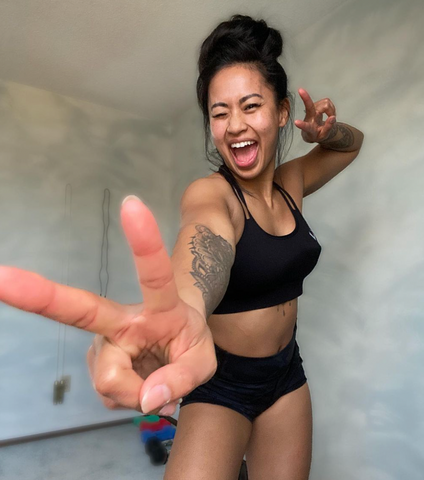
Solinda Hong. Courtesy photo
Bodybuilder Solinda Hong (IFBB Pro, posing coach, and personal trainer) is also a proponent of small goals. She recommends the book "Atomic Habits" by James Clear.
"Tie one habit at a time to a habit you're already doing, and that helps with creating healthy habits," Hong says.
"Atomic Habits" calls this habit-stacking. For example, if you want to do 10 push-ups a day and you already shower every day, you can link the new habit to the existing habit by deciding to do 10 push-ups every day before you shower.
For more info on what Clear says about goal setting, check out some of his writing on the topic.
5. Make it fun.
Do what feels good, Hendryx says. If you hate running, don't set a goal to run a 10K. The entire process of reaching the goal is going to suck. But if your goal is to improve your cardio health and you enjoy HIIT-style workouts, do that instead.
6. Stay accountable.

It's helpful to build into your plan an accountability buddy to call you out on your BS and encourage you when you want to quit, Hendryx says. Hire a coach or trainer or ask a friend or partner to support you, maybe even lift with you. One study found that 22% of people who failed to achieve their resolutions said they didn't have the right support.
An extension of accountability is to create an environment that is supportive of your goals. Strategically align your environment with the life you want to live and make it easy to succeed. If getting to the gym is half the battle, build a home gym in your garage, basement, or unused bedroom. If junk food sets off a spiral, minimize your exposure to it (don't fill your cupboards with chips). For the stretches of the year that make all of this harder, here's how to stay on track during the holidays.

Top Fitness Gear to Help You Keep Your Resolutions
None of this requires equipment. A few pieces just make the follow-through a lot easier, especially on the days when leaving the house is the actual obstacle.
- QuickDraw™ Adjustable Dumbbells replace a dozen pairs of fixed weights, so a full-body workout fits in a corner and takes about 20 minutes.
- The Arcadia® MAX Functional Trainer is a compact cable machine that covers pushing, pulling, and everything in between from one footprint.
- A Strata™ Weight Vest makes walks, runs, and bodyweight work harder without adding anything to your floor.
- Sandbags handle conditioning and strength work, and they travel better than anything else on this list.
Shopping for new gear? REP's Black November sale — our biggest of the year — is coming. Sign up to be the first to know when the deals drop, and check out our Black November FAQs to learn how you can save.
7. Write it down.
Write your goals down and put them where you can see them, whether that's a mirror, a phone lock screen, a sticky note on the fridge, or the car. This isn't just a cutesy move; it's neuroscience. People who clearly describe their goals are 1.2 to 1.4 times more likely to achieve those goals, according to an article in Forbes.
Having it written down also makes it much easier to adjust the goal later instead of quietly abandoning it.
8. Stay adaptable.
Set your systems, but also stay open to other potential avenues of achieving your goal. You will continue learning along the way. So, stay open to expanding or reworking the systems when you gather new information.
For example, if you set out to lose fat by doing a ton of cardio, you may soon learn building muscle is a vital component of that. This may require you to change your plans and let go of the number on the scale, Hendryx says.
9. Measure your progress.

Data is powerful. In fact, 33% of people who failed their resolutions in one study said they didn't keep track of their progress.
The scale is not the only way to measure change. Take progress photos. Track the weight you can move or how long and how fast you can complete a challenge. A journal or an app works fine, as long as you can see the trend over a few months.
There are so many ways to measure progress, but remember, strength and any kind of change are not linear. It's normal to plateau sometimes or appear to be sliding back. Keep going. A plateau is often a sign that you're about to level up, and the only way to find out is to keep going.
10. Reward yourself.
Celebrate the small wins. "Rewards should be frequent and should not contradict the goal, but should enhance your joy in the goal achievement," Hendryx says.
She says she loves to reward hard work with a new tumbler, workout clothes, or a journal. Everybody loves a new hoody.

11. Train your brain.
To achieve a goal, you have to believe it's actually possible and work through some of the limiting beliefs that have held you back in the past. Beware of thoughts that start with phrases like "I can't," "I never," "I always," and replace those with affirming thoughts like "I can," "I do," "I love to," and "I am becoming," Hendryx says.
Part of this belief process is not lying to yourself, she says. There will be obstacles.
"Plan for them, know your weaknesses, and plan for a realistic work-around," she says.
Takeaway
Quitter's Day gets a lot of people because broad goals with no plan behind them are almost impossible to act on. Pick one goal, get clear on why it matters to you, shrink the first step until you can't fail it, and put something in place to hold you to it.
These eleven tips work in January, and they work just as well in July when nobody's watching.
FAQs
Why do most New Year's fitness resolutions fail?
They're usually too broad, too big, and missing a concrete plan. Research on failed resolutions points to unrealistic goals, setting too many at once, lack of support, and not tracking progress as the most common reasons.
How do I set a fitness goal I'll actually keep?
Pick one goal, make it specific and measurable, and connect it to a personal reason that matters to you. Then build a plan that names when, where, and how you'll act on it, and start with a step so small you'd do it on your worst day.
How long does it take for a new fitness habit to stick?
It varies a lot by person and by habit, and the popular 21-day figure has never held up well. Stacking a new habit onto something you already do every day speeds it up considerably.
What should I do when progress stalls?
Keep going and check whether you're measuring the right thing. Strength and body composition change in fits and starts, so track several markers rather than only the scale, and adjust your system instead of scrapping the goal.
Aimee Heckel, CPT, is a health and fitness journalist with over 20 years of experience. She set an all-time world-record deadlift in her division across all powerlifting federations at Mr. Olympia. In addition, she earned a national deadlift record and 18 Colorado state records. Heckel also has nine world records in grip sport, a pro card in natural figure bodybuilding, four first-place bodybuilding titles, and was named IPE Ms. Colorado Figure.
This article was reviewed by Rosie Borchert, NASM-CPT, for accuracy.
similar to this

Tired of Feeling Tired? Exercise Might Be the Ticket
Feeling drained? When to move and when to rest.

Microdosing and the Rise of the Psychedelic Pre-Workout
From tripping balls to slam balls.

NEWSLETTER SIGNUP
Product launch information, promotions, blogs, and REP news.